

Blog
The Murderous Messenger: A deadly lettercraft episode in Bede’s Ecclesiastical History

Anno autem sequente venit in provinciam quidam sicarius vocabulo Eumer, missus a rege Occidentalium / Saxonum nomine Cuichelmo, sperans se regem Eduinum regno simul et vita privaturum; qui habebat sicam bicipitem toxicatam […]
“The following year [626] an assassin named Eomer came to the kingdom, who had been sent by Cwichelm, king of the West-Saxons, hoping that he would gain the king’s kingdom and deprive him of his life simultaneously. He carried with him a double-headed poisoned dagger […]” [1]
In 626 CE, a man approaches King Edwin’s hall in Northumbria claiming to bear a message. It’s Easter Day, one of the holiest days of the year in the medieval Christian calendar.[2] As he walks forth into the crowded room and begins to proclaim his message, he draws his dagger, double edged and coated in poison. He lunges forth, aiming to strike the king down, but his blow is blocked by the body of Lila, one of the king’s retainers, who dies protecting his lord. In the ensuing chaos, the king is wounded and poisoned and another of his retainers is killed. The would-be assassin is ‘rushed from every quarter’, though his ultimate fate remains unknown.
The above rendition of the attack on Edwin is given by Bede in chapter II.9 of his Ecclesiastical History, composed in the 730s. It can also be found in The Anglo-Saxon Chronicle as the entry for 626 CE, possibly based on Bede’s Ecclesiastical History. The chronicle was likely created in the late ninth century, during the reign of King Alfred.[3] An interesting note about this version of the tale is that the author removes all mentions of Eomer posing as a messenger. He is simply someone who comes from King Cwichelm with the intention to stab Edwin. Bede provides a more detailed look at the attempted assassination, giving both method and manner. Eomer is described by Bede as an assassin (sicarius), pretending to deliver a message of this lord (quasi nuntium domini sui referens) on a fake diplomatic mission (simulatam legationem).[4]
What are we to make of Bede’s story, with its particular stress on Eomer’s status as a fake messenger? Bede is writing a history of the church and does not need to include all the details about the manner of attack, as evinced by the perfectly serviceable historical reckoning from The Anglo-Saxon Chronicle. Something about this event must have been striking enough for him to include it.
First of all, it is important to recognize that Bede intended the story to function in a wider story arc revolving around the conversion of King Edwin. The assassination attempt in II.9 acted as a narrative trigger of sorts. Edwin survives the attack and his wife bears him a daughter later that night. While praying over his daughter to his gods, Bishop Paulinus tells him to thank Christ instead. Edwin rejoices and promises to convert to Christianity if he lives through the poisoning and defeats Cwichelm. As a show of faith, he has his daughter baptised on Pentecost. Edwin’s tale ends with him finally converting (II.14), but only after receiving an exhortatory letter from the pope Boniface V (II.10), some further prompting by Paulinus who reminded Edwin of an earlier vow he took in his youth after escaping another attempt on his life (II.12), and a lengthy discussion with his men on the merits of the Christian faith (II.13).[5] On one level, then, the assassination attempt in II.9 was included because it was one of several events that put Edwin and his kingdom of Northumbria on the path towards salvation.
But why the details about the assassin pretending to be an ambassador? By including these details in his narrative, Bede was contributing to a rich tradition of messengers in ancient and medieval literature, albeit from an unusual angle. More often than not, the messenger is a trustworthy representative of their sender, bringing news whether it be positive or negative. In Greek tragedy, for instance, the messenger is a stock figure: a neutral observer, providing crucial details to the plot or relating events that happened off the stage.[6] Sometimes, it is the messenger who has to fear for their life in ancient literature. Plutarch’s Life of Lucullus sees the Armenian king Tigranes kill a messenger for bringing him bad news.[7] In Sophocles’ Antigone, a city guard does not want to deliver bad news to the hard-nosed Creon out of fear of reprisals.[8] High Medieval German courtly literature hints at the use of pain to discipline messengers, aiding their memorization and recitation, and instilling fear when delivering their message.[9] In J.R.R. Tolkien’s Lord of the Rings, a much later example though one inspired by Anglo-Saxon culture, the Mouth of Sauron fears injury and claims that he cannot be harmed as he is a messenger.[10] If anyone is in danger in the above examples, it is the messenger, walking into a foreign or hostile environment, and facing the potential wrath of both sender and recipient.
Bede’s episode goes in a different direction. It has more affinity with early medieval Frankish historiography. In Gregory of Tours’ Histories, the Merovingian queen Fredegund is seen routinely to send assassins to get rid of her enemies, several of which pretend to deliver a message or act as ambassadors.[11] In Fredegar’s Chronicle, messengers are sent to convey killing orders or lure people into a trap.[12] Not all such stories can be taken at face value. Trickery and deceit made for exciting narrative; in the case of Queen Fredegund, it also helped Gregory to proffer moral judgment. Bede’s story sounds like a formulaic tale of a king being saved by his retainers. But the addition of the names of the assassin and theigns would have lent the story historical veracity, whether it was actually based on fact or not.[13] More generally, for such stories to work they would have appealed, at least to an extent, to contemporary norms and expectations surrounding messengers.
So what do we learn? One thing that this episode confirms is that receiving a message from another king was expected to be a semi-public affair in early medieval England. This fits wider patterns surrounding high profile embassies in early medieval diplomacy.[14] Eomer gains admission and begins telling of his mission while there are multiple people in the hall, most clearly evidenced by the two men who died for their king. More must have been beside them as Bede describes how Eomer is being ‘rushed with swords from all sides’ (undique gladiis inpeteretur) after he managed to wound the king and kill the first of his retainers.[15] Apparently, someone bearing, or claiming to bear, a message from one king to another could expect to be given an audience and this audience would normally be public.
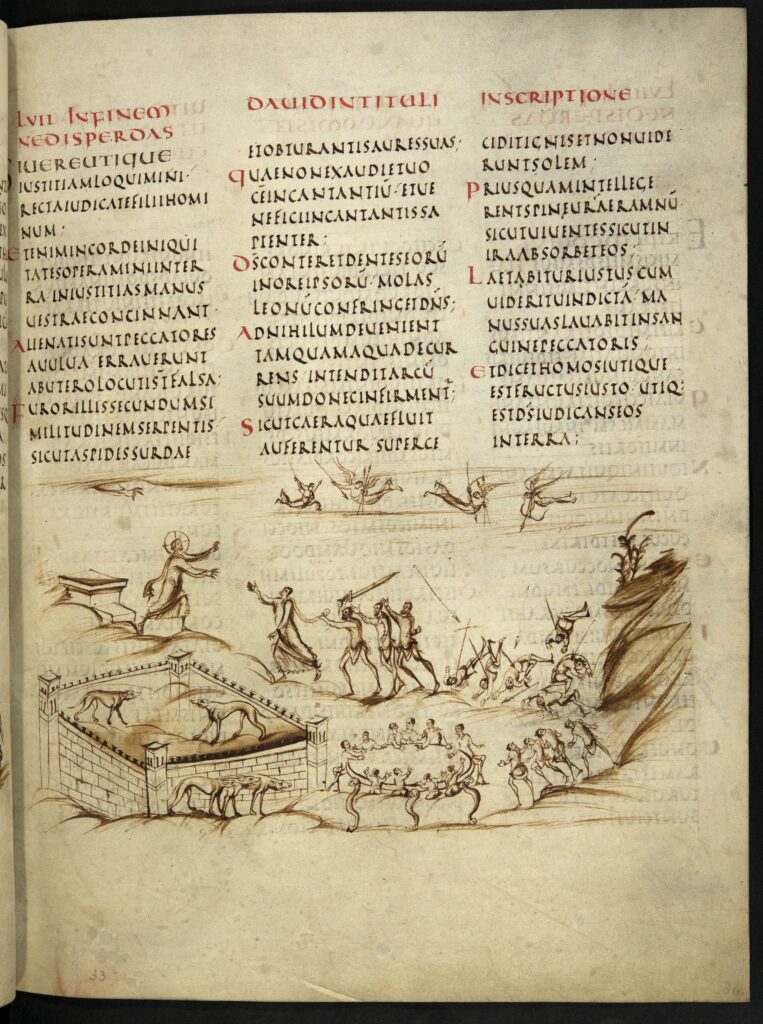
Utrecht Psalter (c. 830), fol. 33r: Carolingian illustration accompanying Psalm 58 (Hebrew no. 59): David prays for God’s protection when Saul sends assassins to his home. NB: the text of psalm 58 is on the verso side (33v). Copyright: Utrecht University Library, Special Collections, https://psalter.library.uu.nl/page/73
Second, Bede’s scene underlines the importance of persuasive oral communication in high profile diplomacy. Sometimes, messengers would bring along a letter of credence to identify themselves, but this was not always the case.[16] Bede, at any rate, does not refer to any such letter. He does describe Eomer as having a ‘cunning mouth’ (ore astuto), with which he ‘spun out his pretended diplomatic mission’ (simulatam legationem…volveret) in front of the king and his courtiers.[17] The suggestion seems to be that Eomer turned up pretending to carry on oral message, without a letter proving the legitimacy of his mission, relying on his rhetorical skill to get close to the king. Moreover, the fact that the king knows who to go to war against for the attempt on his life, would indicate that Eomer began delivering his false message with an explanation of who sent him. This fits other early medieval descriptions of diplomatic interaction, where greetings and a statement of credentials precede the delivery of the message.[18]
A final thing that this episode can show us, paradoxically, is Bede’s ideal view of the messenger as a trusted individual. Messengers are active throughout the Ecclesiastical History. In his prologue to the work, Bede himself describes using the priest Nothlem to acquire information from various English authorities and Rome.[19] Other messengers are sent to and from kings and bishops without issue and without any question of the veracity of the message. Eomer at first also does not seem to face much difficulty in the, albeit limited, description we have of his assassination attempt. He was able to get an audience with the king while holding onto a deadly weapon on what seems to be little more than his word. In this audience, he was able to get very close to the king, close enough to reach Edwin even with another body in the way. This would indicate that in Bede’s experience, messengers were usually a trusted group. Such trust was essential both for the addressee and the sender. Early medieval letter-writers took great care selecting the right person to deliver their writings. The carrier would represent them at their destination. Beyond facing the challenges of travel and route-finding, the messenger could be expected to represent the writer to the addressee, offering translation and commentary on the letters delivered, and carry back any replies.[20] Sometimes it was opportune to select a messenger who was already known to the addressee.[21] If Eomer was known to Edwin, this would add an extra layer to the betrayal of having him act as an assassin.
In Bede’s Ecclesiastical History, messengers are usually an unremarkable part of the fabric of the tale. The messengers serve to bring texts, warnings, summons, letters, and ask questions of distant sources. They are seemingly trusted and given little doubt. By playing as one of these messengers in his assassination attempt, Eomer breaks the pattern. This fits the crucial position of the story in the larger tale of Edwin’s conversion. But it also calls attention to aspects of medieval communication that remain implicit in the text: the public nature of (letter-)delivery, the importance of persuasive oral communication, and the mutual trust that enabled messengers to act as intermediaries between sender and addressee.
[1] Bede, Historia ecclesiastica gentis Anglorum, ed. Bertram Colgrave and R.A.B. Mynors, Bede’s Ecclesiastical History of the English People (Oxford, 1969), II.9, 164-165.
[2] Nicholas Orme, “The Seasons and the Year,” in Going to Church in Medieval England (Yale, 2021).
[3] Michael Swanton, Anglo-Saxon Chronicles, 2nd ed. (Phoenix Press, 2000), xviii.
[4] Bede, Historia ecclesiastica, II.9, 164-165.
[5] C. Cubitt, “Narrating Providential History: Bede’s Account of the Conversion of King Edwin of Northumbria in His Historia Ecclesiastica,” Early Medieval Europe 33, no. 1 (2025): 37-38; J. Barrow, “How Coifi Pierced Christ’s Side:
A Re-Examination of Bede’s Ecclesiastical History, II, Chapter 13,” Journal of Ecclesiastical History 62, no. 2 (2011): 693-706.
[6] James Barrett, “Introduction,” in Staged Narrative: Poetics and the Messenger in Greek Tragedy (University of California Press, 2002).
[7] A.H. Clough, trans., “Lucullus,” in Plutarch’s Lives, vol. 3 (John D. Morris & Company, 1860).
[8] Sophocles, Antigone, trans. Richard Claverhouse Jebb, The Tragedies of Sophocles (Cambridge University Press, 1917), l. 225-238, pp. 134-135.
[9] Scott E. Pincikowski, “Schmerzvolle Erinnerungen: Schmerz, Gedächtnis Und Identität in Der Deutschen Literatur Des Mittelalters,” in Schmerz in Der Literatur Des Mittelalters Und Der Frühen Neuzeit, ed. Hans-Jochen Schiewer et al. (Göttingen, 2010), 23-50.
[10] J.R.R. Tolkien, “The Black Gate Opens,” in Lord of the Rings (George Allen & Unwin, 1955; repr., Harper Collins Publishers, 2007).
[11] Gregory of Tours, Libri historiarum decem, ed. B. Krusch, MGH SS rer. Merov. 1.1 (Hannover, 1951), IV.51, V.14,18, VII.20, VIII.28-29, 31, 44, X.18.
[12] Fredegar, Chronicle, trans. IV.40, pp. 32-33; IV.90, pp. 75-76.
[13] Cubitt, “Narrating Providential History,” 43.
[14] A. Gillett, Envoys and Political Communication in the Late Antique West 411-533 (Cambridge, 2003), 249-250.
[15] Bede, Historia ecclesiastica, II.9, 164-165.
[16] Gillett, Envoys and Political Communication, 247.
[17] Bede, Historia ecclesiastica, II.9, 164-165.
[18] See e.g. Gregory of Tours, Libri historiarum decem, VIII.13, p. 379: Felix legatus, salutatione praemissa, ostensis litteris, ait […].
[19] Bede, Historia ecclesiastica, prologue, pp. 4-5
[20] V. Scior, “Stimme, Schrift und Performanz. “Übertragungen” und ,Reproduktionen’ durch frühmittelalterliche Boten”, in: Übertragungen: Formen und Konzepte von Reproduktion in Mittelalter und Früher Neuzeit, ed. B. Bußmann (Berlin, 2005), pp. 77–100.
[21] P. Allen, “‘Christian Correspondences: the Secrets of Letter-Writers and Letter-Bearers’, in: The Art of Veiled Speech: Self-Censorship from Aristophanes to Hobbes, ed. H. Baltussen (Philadelphia, 2015), pp. 209-232.