
Blog
Meaningful objects in the Liber Historiae Francorum

One of the insights of the Lettercraft project is that early medieval societies did not only communicate through letters, but also through other kinds of objects like gifts and relics. Often, the object is accompanied by a written or oral message. In certain cases, the object itself is the message. This blogpost focuses on the special communicative meaning of objects in the Liber Historiae Francorum in comparison to Gregory of Tours’ Histories.
The Liber Historiae Francorum (henceforth LHF) is an early eighth-century chronicle that was composed by an anonymous Frankish author working from Neustria. It deals with the history of the Franks up to the inauguration of King Theuderic IV in 720 CE. The author utilizes various earlier works, including Gregory of Tours’ Histories.[1] Modern scholars have noted that although the author of the LHF relied heavily on the Histories, he was extremely selective in what passages and chapters he incorporated, and supplemented what he took from Gregory with new stories, details and accents. By doing this, the author effectively rewrote Gregory’s approach to Frankish history and established a new model of community.[2]
The LHF also adopted from Gregory several striking passages involving communication through objects. In what follows, we will look at four such episodes, including a fifth one that is not attested in Gregory’s work.
Clovis’ ring
The first shared story revolves around the Burgundian princess Clotild and her marriage to the Frankish king Clovis. Gregory and the LHF commence in more or less the same manner:
‘Since Clovis frequently sent legations (legationem) into Burgundy, it happened that the girl, Clotild, was noticed by the legates (legatariis). These legates noticed Clotild’s beauty, grace and intelligence, and told Clovis.[3]
When Clovis learned of this, he sent another embassy to the Burgundian king Gundobad with the request to marry his niece. According to Gregory, the request was quickly granted: Gundobad did not dare refuse Clovis and handed Clotild over to the Franks. The LHF, by contrast, offers an extensive report on how the Frankish legate, who is identified as Aurelianus, managed to convince both Clotild and the Burgundian king.
When Aurelianus arrives in Burgundy, he does not directly approach king Gundobad. Instead, he contrives to speak to Clotild in private by disguising himself as a pauper, knowing the princess is accustomed to give alms to the poor. Having caught her attention by drawing back her cloak, he is summoned by Clotild to his chamber. He reveals his identity and he informs her that Clovis desires to marry her. By way of evidence, he shows her a sack filled with betrothal ornaments, and a ring that belongs to Clovis. He gives her the ring as a present, and she stores it in her uncle’s treasury. She accepts Clovis’ proposal, and Aurelianus returns to Clovis to report the good news.
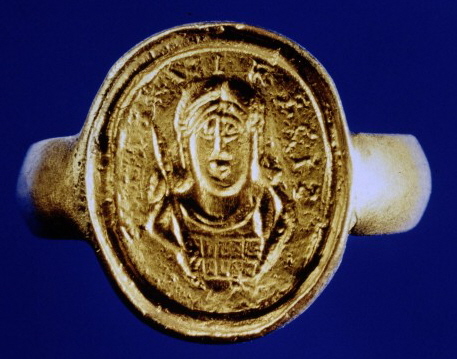
A copy of the signet ring of the Frankish king Childeric (Clovis’ father, who died in 481), with the inscription CHILDIRICI REGIS. The original was stolen. Source: wikipedia commons.
Clovis, however, knows he also needs Gundobad’s approval, so he sends Aurelianus to Burgundy once more. The Burgundian king becomes furious upon hearing the request, thinking Clovis is seeking a cause for war. Gundobad’s councilors advise the king to check his treasury for any gifts from Clovis, which the Frankish king might use as a pretext for armed conflict. The Burgundians find the ring with Clovis’ name and inscription. Gundobad asks his niece whether she knows anything about the ring, and she admits that she received it from Clovis’ messengers. Realizing he must now choose between a Frankish marriage or a war, Gundobad hands Clotild over to Aurelianus, who takes her to Clovis to be his wife.
It is unclear why and on the basis of what source the LHF expanded Gregory’s story.[4] Possibly, the author thought it fitting to provide an explanation as to why Gundobad did not dare refuse Clovis’ request. Whatever the motives, the LHF’s story underlines the communicative potential of objects, especially in a situation demanding secrecy and covert maneuvering. Clovis seeks to approach the Burgundian princess without the Burgundians knowing it. Rather than risking a letter, which could be intercepted, he sends a trusted messenger with an oral message. The objects Aurelianus carries with him, the royal ornaments and the signet ring, are probably meant to convince the princess that he really speaks on Clovis’ behalf. The objects are thus complementary to the oral message which Aurelianus wants to convey.
A blood smeared handkerchief and royal hair
This episode is not the only place in the LHF where objects underscore an oral message. Another telling episode revolves around the Frankish princess Clotild (Clovis’ daughter), who is beaten by her Visigothic husband Amalaric on account of her Catholic faith. Desperate, she sends a handkerchief (sudarium) smeared with her own blood to her brother Childebert, who gathers a force and comes to hear aid. For Gregory, the handkerchief was enough to convey Clotild’s call for aid.[5] The LHF adds envoys (nuncios) and an explicit oral message: ‘avenge my hardship and injuries, sweet brothers, dear lords!’.[6] The addition raises the question of priority: was it the bloody handkerchief or the oral message that prompted Childebert to action? The handkerchief was certainly an essential piece of evidence. And while silent, it was a powerful statement.
We see a comparable phenomenon in chapter 41 of the LHF, which tells a story that does not derive from Gregory. The story revolves around the junior Merovingian King Dagobert I, who is ambushed across the Rhine by a Saxon army.[7] The Saxons manage to cut off part of his long hair – the symbol of Merovingian royalty.[8] Dagobert, in distress, tells his standard bearer to travel to his father Clothar II to ask him to come to their aid. To underscore the message, the messenger is to present the hair which the Saxons cut off. According to the LHF, it was the sight of the ‘torn-off locks of his son’ (abscisa crine filii sui) that moved Clothar to great grief and prompted him to ride out into the night, seeking vengeance.
Scissors or sword
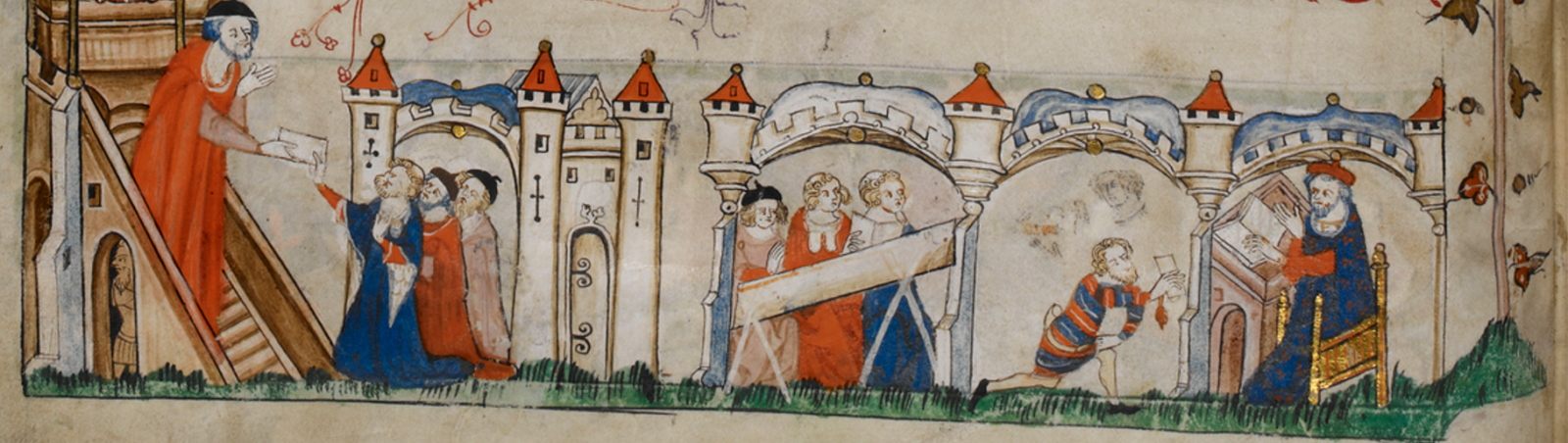
In the above passages, a sender assumes, correctly, that showing visceral evidence of their distress (blood or hair) will impress the receiver to such an extent that the latter will be driven to come the sender’s aid. But interpreting an object was not always so straightforward. Its message could be misinterpreted, or consciously misrepresented by the carrier. This is the case in a famous story revolving around the elder Clotild.[9] Her husband Clovis has already died, and so has her son Chlodomer, whose children are staying with her in Paris. This is not to the liking of her surviving sons, Childebert I and Clothar I, who fear that the boys will form a threat to their position, and thus decide to do away with them. They send a messenger, Arcadius, to Clotild, deceitfully asking her to send them the boys so that the brothers can make kings of them. Clotild believes this message, and she sends the boys to their uncles. But when the boys have arrived in their keeping, Childebert and Clothar send Arcadius to Paris once more, to deliver a dire message to their mother:
‘These are scissors, and see here a sword. Thus tell your sons if you wish them to tonsure the boys or to kill them with the sword.’[10]
The messenger conveyed on oral message whilst showing two objects: scissors and sword, symbolizing the choice between having the boys tonsured (i.e. making them a monk, and thus neutralizing them as a political threat) and having them killed.[11] Clotild’s response is well known: the loving grandmother picked the sword, after which the two elder boys were killed, with only the third boy, Chlodovald, escaping. But this is not the whole story. Both Gregory and the LHF suggest something was lost in translation when Clotild gave her response, though they offer different readings of where things went wrong and who was to blame. Gregory stresses the emotional impact of the objects shown to the aging queen: Clotild was moved to such ‘fear and anger’ (exterrita nuntio et nimium felle commota) that she picked the sword out of bitterness and distress, without fully knowing what she was doing (ignorans in ipso dolore quid diceret). The messenger Arcadius, in turn, failed to give Clotild any time to come to her senses (parum admirans dolorem eius, nec scrutans, quid deinceps plenius pertractaret) and departed straightaway. The LHF seems to blame the messenger even more: Clotild said it was better for her grandsons to die than to be tonsured, but probably meant this to illustrate the cruelty of the choice given to her. Arcadius misrepresented her words to Childebert and Clothar (renunciavit eis falsum), who proceeded to kill the boys.
To an extent, these different nuances represent different authorial agendas. Gregory framed Clotild as a saintly figure but was not always impressed by her political acumen.[12] She could have handled this particular communication better. The LHF is known for portraying Clotild as a clever and self-confident political actor,[13] and thus shifts the blame entirely onto the messenger. It is unclear whether Arcadius went off script as an intermediary or whether the miscommunication was part of the brothers’ plan all along. Certainly, the brothers deliberately sent objects to evoke an emotional reaction in their mother. Gregory, moreover, has Arcadius report back to the brothers that Clothild ‘agrees to your plan’ (ipsa vult explere consilium vestrum), suggesting they preferred to kill their nephews. Knowing that giving their mother time to think might prompt her to pick the scissors over the sword, they could have instructed their messenger to depart immediately after receiving their desired answer. In the LHF, the question hinges on the interpretation of the phrase falsum renunciavit: did Arcadius mislead both parties by misrepresenting the spirit of Clotild’s words, or did he bring back the verdict that the brothers had instructed him to get? Ultimately, both versions stress the double-edged nature of communicating through objects: their emotional impact made them a powerful tool of persuasion, but they could also escalate or derail an exchange, either because the messenger failed to mediate properly, or because one of the parties was intend on escalation.
The divided coin
One way to negotiate this difficulty, was by limiting the possible interference of the messenger. Rather than having an object be accompanied by a written or spoken message, the object itself could be made to function as the message. There is one episode that shows this in practice. It revolves around Clovis’ legendary father, Childeric.[14] Due to his adulterous ways, the Frankish king Childeric hears that his subjects are angry with him and want to throw him out of the kingdom. Knowing he will go into exile, Childeric consults a trusted friend, which the LHF identifies as Wiomad.[15] In this meeting, they divide a golden coin, with each of them taking one half, and agree to use this divided coin as a coded signal to alert Childeric when he can safely return to his kingdom. Childeric then flees to Thuringia, and Wiomad sets to convincing his fellow-Franks to accept Childeric again as their ruler. When the time is right, he sends his piece of the golden coin to Childeric. The latter understands the sign: the Franks want him back. Childeric returns to his kingdom and is re-accepted as king.
While neither Gregory nor the LHF spell out the reason for relying on a coin, the purpose seems clear: it was a safe way secretly to convey a delicate private message and minimizing the risk of publicity and interference. This reflects a broader challenge in early medieval communication: letters had a tendency to go public. A trusted letter-bearer could mitigate this risk, by making sure a letter was delivered only to the intended receiver.[16] But even trusted messengers could be overpowered and their letters seized. Another option was to rely solely on verbal messages (maybe even in a code language), but this meant relying entirely on the messenger to convey what was intended, a risk that could not always be taken. Childeric and Wiomad went for a third strategy: to ascribe a certain meaning to an object, which they alone know. When the time is right, the sender does not have to think about the trustworthiness of the messenger, only about getting the object to the receiver. The receiver, in turn, need only remember the meaning ascribed to the object. This aspect of memorization is stressed by both Gregory and the LHF: Childeric recognizes the coin and immediately understands it as a ‘certain signal’ (certa indicia) that he can safely return.
Conclusion
Both Gregory and the LHF emphasize the diverse role objects could play in early medieval communication. Objects could complement written or oral messages, prompting an emotional reaction that words could not. They could thus be powerful tools of persuasion, even though wielding this tool was not without risk: the object could be misinterpreted by the receiver, the messenger could muddle its message, or the emotional impact could prompt the wrong reaction. When things were set up rightly, objects could even serve as stand-alone messages, requiring no further elaboration. In secret communication, they offered an alternative to the oral message or letter, albeit an alternative that is attested infrequently in our Merovingian sources.
[1] P. Dörler, ‘The Liber Historiae Francorum — a Model for a New Frankish Self-confidence’, Networks and Neighbours 1.1 (2013) 23-43.
[2] H. Reimitz, History, Frankish Identity and the Framing of Western Ethnicity, 550-850 (Cambridge 2015) 242.
[3] Liber Historiae Francorum, ed. B. Krusch, MGH SS rer. Merov. 2 (Hanover, 1888), cap. 11-12, pp. 253-258; trans. B.S. Bachrach’s Liber Historiae Francorum (Lawrence, KS, 1973), pp. 36-40; compare Gregory of Tours, Libri historiarum decem, ed. B. Krusch, MGH SS rer. Merov. 1,1 (Hanover, 1951), II.28, pp. 73-74, in which the messengers are referred to as legati, and report on Clotild’s royal lineage in addition to her beauty.
[4] R. Gerberding, A Critical Study of the Liber Historiae Francorum (Oxford, 1982), p. 257 refers to it as a ‘colourful popular legend’, and hypothesizes the author might have heard it in Soissons.
[5] Gregory of Tours, Libri historiarum decem, III.10, pp. 106-107.
[6] Liber Historiae Francorum, cap. 23, pp. 278-279, trans. Bachrach, pp. 61-62
[7] Liber Historiae Francorum, cap. 41, pp. 311-314, trans. Bachrach, pp. 97-99.
See on this story, R. Flierman, Saxon Identities AD 150-900 (London, 2017), pp. 82-84.
[8] E. Goosmann, ‘The Long-haired Kings of the Franks: “Like So Many Samsons?”’, Early Medieval Europe 20 (2012): 233–59.
[9] Liber Historiae Francorum, cap. 24, pp. 279-282, trans. Bachrach, pp. 63-64; Gregory of Tours, Libri historiarum decem, III.18, pp.117-120.
[10] Liber Historiae Francorum, cap. 24, p. 280: At illi statim remiserunt Archadium ad reginam, dicentes: “Haec sunt forfices, et ecce! gladius. Sic mandant filii tui, si vis tundere aut gladium peremere”, trans. Bachrach, p. 63.
[11] The showing of objects is made explicit in Gregory of Tours, Libri historiarum decem, III.18, pp.117: Tunc Childeberthus atque Chlothacharius miserunt Archadium, cui supra meminimus, ad reginam cum forcipe evaginatoque gladio. Qui veniens, ostendit reginae utraque, dicens: “Voluntatem tuam, o gloriosissima regina, fili tui domini nostri expetunt, quid de pueris agendum censeas, utrum incisis crinibus eos vivere iubeas, an utrumque iugulare”.
[12] E.T. Dailey, Queens, Consorts, Concubines. Gregory of Tours and Women of the Merovingian Elite (Leiden 2015), pp. 39-43.
[13] M. Hartmann, ‘Die Darstellung der Frauen im Liber Historiae Francorum and die Verfasserfrage‘, Concilium medii aevi 7 (2004), pp. 209-237, here 221.
[14] Liber Historiae Francorum, cap. 6-7, pp. 247-250, trans. Bachrach, pp. 29-31; Gregory of Tours, Libri historiarum decem, II.12, pp. 61-62.
[15] The friend remains anonymous in Gregory’s Histories, which does offer more details concerning Childeric’s sexual license.
[16] P. Allen, ‘Christian Correspondences: The Secrets of Letter-Writing and Letter-Bearers’, in H. Baltussen and P.J. Davis eds., The Arts of Veiled Speech: Self-Censorship from Aristophanes to Hobbes (Philadelphia 2015), pp. 209-232.