
Blog
Letters and messengers: more dangerous than assassins?
 A frequently recurring theme in Gregory of Tours’ Histories is the sending of assassins by Queen Fredegund.[1] Her track record is extensive. Gregory claims she orchestrated the assassinations of King Sigibert I, Bishop Praetextatus of Rouen, an anonymous accuser, and three Franks embroiled in a feud.[2] He also implicates her in the death of her step-son Clovis, and an attempt on the life of Merovech. In the later books, her principal royal targets are Queen Brunhild, King Childebert II and King Gunthram.[3] In these cases, her assassins are always stopped before they can execute their plans, but they do reach quite far into enemy territory on their quest. Gunthram is particularly effected by the threats against his person and kingdom. He takes the precaution of being guarded at all times, even when going to church or visiting holy places.[4] Besides physical protection, he also tries to defend himself in another way: by taking far-reaching measures against the alleged threat posed by letters and messengers. This blogpost will focus on one such episode, exploring the king’s troubled, and potentially paranoid, approach to the dangers of lettercraft.

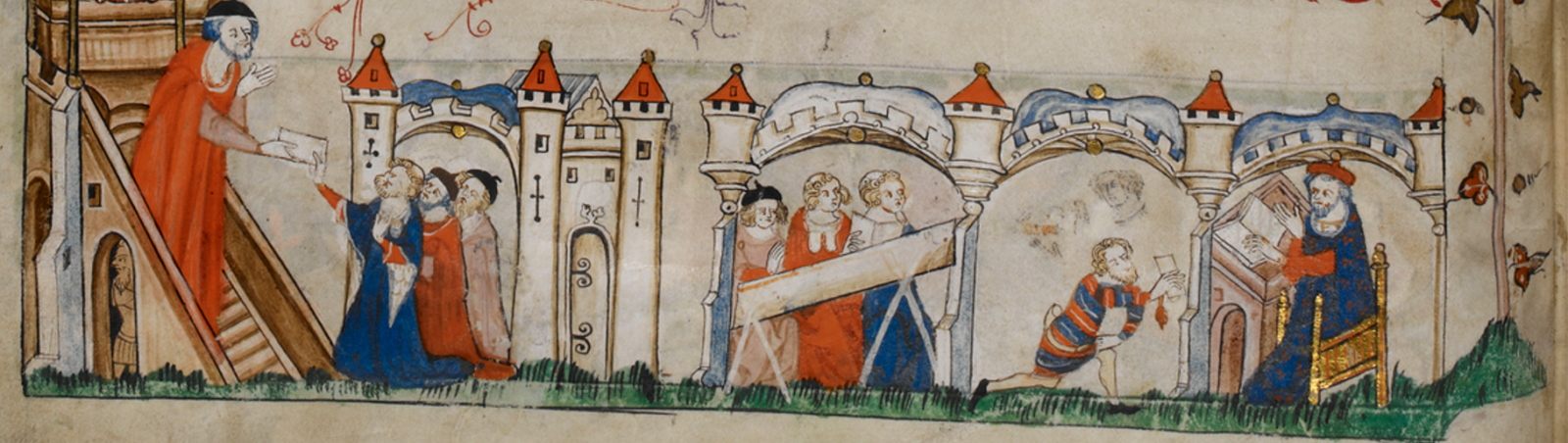
A poor man warns Gunthram, while Fredegund orders the execution of a clergyman. Detail from Chroniques de France ou de Saint Denis (14th century), British Library: Royal 16 G VI f. 69. Source: wikipedia commons
Brunhild’s Spanish envoy
In book IX chapter 28, Queen Brunhild sends her trusted legate Ebregisil to Spain, to deliver lavish wedding gifts for the royal wedding of her daughter Chlodosind to King Reccared I. Gunthram hears about the departure of Brunhilde’s messenger, and someone convinces him that the gifts are being sent to the sons of the deceased pretender Gundovald, to invite them to invade Gunthram’s kingdom. The king thereupon orders a strict surveillance of all the roads in his kingdom. He sets guards and gives them the job to stop and frisk everyone, searching their clothing, luggage and even their shoes for secret letters (occultae litterae).[5]
What to make of these measures? To an extent, they can be explained by Gunthram’s difficult relationship with the Visigothic kings. Gregory provides the details over the course of his Histories.[6] Gunthram had been in conflict with the Visigoths in Spain for some time, launching attacks on Septimania, still under Visigothic rule at this point, but was held off by the Arian King Leovigild (d. 586). Attempts to settle the dispute failed and the conflict continued under Leovigild’s successor Reccared I. Reccared eventually changed diplomatic tactics and sent separate envoys to Gunthram and Childebert II. This strategy paid off, as Childebert made peace with the Visigothic king, but Gunthram refused to see the Spanish embassy. After Reccared converted to Catholicism in 587 CE, he managed to drive a further wedge between Gunthram and his nephew Childebert II, by asking to marry Childebert’s sister, Chlodosind. Childebert sent an embassy to his uncle to ask him to support the marriage, knowing full well that the relations between Gunthram and Spain were poor. Luckily, none other than Gregory was part of this embassy, and he was able, by his own account, to convince Gunthram that Childebert would uphold the recent treaty of Andalot (587 CE), prompting Gunthram to give his blessing to the marriage.[7] While a crisis was averted, Gunthram remained suspicious about a potential alliance between Childebert and the Visigoths.[8] When Brunhild, Childebert’s mother, sent her envoy to Spain, these suspicions would certainly have been aroused.
A response of paranoia
But Gregory seems to suggest there is more going on in chapter XI.28. Gunthram’s response also fits one of his broader character traits in the Histories: paranoia. Ian Wood lists paranoia as one of several negative traits that Gregory attributes to the otherwise ‘good’ king Gunthram.[9] A related trait is his maltreatment of envoys, which ranged from a stubborn refusal to receive them, to torturing envoys who came under a banner of safe-conduct.[10] Such conduct would have instilled fear in those surrounding the king. Guy Halsall has argued that such fear also informed Gregory’s shifting reporting on the king in the Histories. When Tours came under Gunthram’s reign in 584, Gregory adopted a ‘new writing strategy’, bestowing measured (but by no means universal) praise on Gunthram, while ramping up his criticism of the king’s enemies, especially the recently deceased Chilperic.[11]
There is certainly ambivalence to Gregory’s treatment of Gunthram’s paranoia. The king’s suspicions are excessive, but not unwarranted. When the pretender Gundovald was still alive, a secret letter hidden under a writing tablet was discovered by Gunthram’s men.[12] His distrust of Visigothic machinations can be traced back to the discovery of a secret and potentially forged letter, in which King Leovigild suggested that Fredegund should let Childebert II be assassinated to make peace with Gunthram.[13] Fredegund in fact ended up sending assassins to both Childebert and Gunthram. Her attempt on Gunthrams’s life involved dispatching a group of legates who hired a local cutthroat. By chance, the assassin was found armed but asleep in the church where Gunthram went to celebrate Matins.[14] All things considered, the king had good reasons to distrust messengers and letters coming in from other kingdoms.
Elaborate planning
Suspicion – warranted or not – might explain why Gunthram had informants at the court of Childebert and Brunhild, telling him of their movements. Still, his reaction to Brunhild’s Spanish embassy remains slightly confusing. He knew of the gifts sent by the queen, but presumably the informant would also have told him about the nature of her gifts: a very large golden shield beset with gems and two wooden vessels decorated in the same way. It is hardly feasible that such objects could have been hidden, let alone under clothing. Writing about Merovingian epistolary gifts, Alice Tyrell notes that gifts could make the job of the messenger or letter-carrier much harder, especially if they were big, unwieldy, and valuable, as Brunhild’s gifts were. Such items typically necessitated a larger travel party, including armed men accompanying the messenger for protection.[15]
Brunhild’s embassy to Spain was a calculated production. This is evinced by her choice of envoy. Ebregisil was a man with experience in acting as an ambassador to the Visigoths. Gregory indicates that he had been a part of several earlier embassies sent to Spain.[16] This suggests, in turn, we are dealing with the ideal type of messenger or letter-carrier, as described by Pauline Allen: someone who was “deliberately chosen, trusted, and familiar to the letter-writer and possibly also to the recipient”.[17] All these criteria were met in the person of Ebregisil. Brunhild was handling the sending of her wedding gifts with more thoroughness than most. It seems likely, therefore, that she would also have sent protectors to accompany Ebregisil, to make sure that the gifts actually arrived at their destination.
Detection of a large embassy carrying with them precious and bulky items should have been no problem for Gunthram. So why would he let all the roads be searched upon hearing about Brunhild’s embassy? Gregory suggests that Gunthram was not in fact searching for the gifts, but for a letter sent separately from the gifts to the same recipient. It was common practice in the Merovingian period for gifts and letters to be sent together, delivered by the same messenger or group.[18] Gunthram, however, seems to consider the possibility that a letter might have been sent separately instead. We could maybe infer from this that Gunthram had himself sent gifts and letters by different messengers, or that he knew of others doing so, to hide the intent or recipient of the gift. Hard-won experience might also have informed his order to search shoes, which seems oddly specific, but not that outrageous, considering Gundovald’s earlier attempt to bypass Gunthram’s guards by hiding letters under a writing tablet.[19] Marie-Josèphe Bossan describes the Merovingian shoe as a continuation of the Roman shoe, with straps rising to mid-thigh.[20] This would certainly leave enough space to hide a letter.
The conflict comes to a head
Gunthram’s surveillance measures seem not to have resulted in any secret letters being uncovered. Ebregisil, however, did find himself arrested by one of Gunthram’s officials when he entered Paris. He was brought before the king, who, in another show of paranoia and cruelty towards envoys, threatened to execute Ebregisil for conspiring against him. Caught in a tight spot, Ebregisil showed his worth as an envoy, for he was somehow able to convince the king of the harmless nature of his assignment and secure his release.[21] Gregory does not report on the conclusion of his embassy. There are indications, however, that the marriage between Brunhild’s daughter and the Visigothic king was cancelled for some reason, as Reccared later married a Gothic lady named Baddo.[22]
This was not the end of Gunthram’s suspicions. In chapter IX. 32, Gregory relates how the issue of Spain once again created tension between Gunthram and Childebert II. Gunthram had led another failed attempt to invade Septimania and this time he explicitly blamed the alliance between his nephew and the Visigoths for its failure. He imagined a large conspiracy set up against him, involving Brunhild and Childebert’s son Theoderic. In response, he closed the borders between his kingdom and Childebert’s, not letting anyone from Childebert’s kingdom travel within his own territory.[23] Presumably, this was an effective way of sabotaging the alliance between Reccared and Childebert, as envoys between them were frequent and ideally travelled through Gunthram’s kingdom.[24] It was, however, also a severe measure, requiring a power and bureaucratic apparatus that might have gone beyond what a sixth-century Merovingian king could actually wield. Gunthram certainly invested many resources, inviting all the bishops of his kingdom to a synod where they would sit in judgement on the alleged conspirators. In the end, most bishops could turn around before they arrived at their destination, because Brunhild swore an oath that there was no conspiracy against Gunthram. Set at ease, the king opened the borders again, letting anyone through who wished to go to Childebert’s kingdom.[25] This is a telling conclusion to an already suggestive episode, as it indicates the border closure went both ways, not only keeping Childebert’s people out, but also locking Gunthram’s people in. This would have negatively impacted Gunthram’s kingdom, further showing how serious he took the issue.
Conclusion
Gunthram’s response to Brunhild’s Spanish embassy gives us a tantalizing insight into the role of letters and messengers in Merovingian politics. The episode underlines the importance of envoys to broker and keep up alliances, as well as the suspicion such communications could generate amongst those left out of the loop. It also shows us the difficulty of managing such suspicions. Gregory presents Gunthram as a good king given to paranoia. This led him to be guarded physically at all times and to distrust and abuse envoys and messengers. While he had reasons to be afraid, his suspicions escalated his poor relationship with the Visigothic court and almost resulted in a major crisis with his nephew Childebert II. For Gunthram, therefore, the messenger seems to have posed a greater threat than the assassin. For whereas he could guard himself against the poisoned knife, he needed much more elaborate, and destabilizing, measures against the gift and the letter.
[1] See Erin Dailey, Queens, Consorts, Concubines: Gregory of Tours and Women of the Merovingian Elite (Leiden, 2015), pp. 118-128.
[2] Gregory of Tours, Libri historiarum decem, ed. B. Krusch, MGH SS rer. Merov. 1.1 (Hannover, 1951); trans. F. J. A. M. Meijer, Gregorius van Tours. Historiën (Baarn, 1994), King Sigibert I (IV.51), Praetextatus of Rouen (VIII.31, 41), an anonymous accuser (VIII.31), three Franks embroiled in a feud (X.27); Chilperic’s son Clovis (V.39, VII.7); Merovech (V.14, 18).
[3] Gregory of Tours, Libri historiarum decem: Brunhild (VII.20), Childebert II (VIII.28-29, X.18), Gunthram (VIII.44)
[4] Gregory of Tours, Libri historiarum decem, VII.8, p. 331; VII.18, p. 338.
[5] Gregory of Tours, Libri historiarum decem, IX.28, pp. 446-47.
[6] See for an overview Edward James, “Gregory of Tours, the Visigoths and Spain,” in Cross, Crescent and Conversion: studies on medieval Spain and christendom in memory of Richard Fletcher, ed. Simon Barton and Peter Linehan (Brill, 2008), pp. 43-64.
[7] Gregory of Tours, Libri historiarum decem, IX.20, pp. 439-440.
[8] James, “Gregory of Tours,” 61.
[9] Ian Wood, “The secret histories of Gregory of Tours,” Revue belge de philologie et d’histoire 71, no. 2 (1993): 260, https://doi.org/10.3406/rbph.1993.3879
[10] Gregory of Tours, Libri historiarum decem, VII.32.
[11] Guy Halsall, “Nero and Herod? The Death of Chilperic and Gregory’s Writing of History,” in The World of Gregory of Tours, ed. Kathleen Mitchell and Ian Wood (Brill, 2002), 347-49.
[12] Gregory of Tours, Libri historiarum decem, VII.30, p. 350.
[13] Gregory of Tours, Libri historiarum decem, VIII.28, pp. 390-91.
[14] Gregory of Tours, Libri historiarum decem, VIII.44, pp. 410-11.
[15] V. Alice Tyrell, Merovingian Letters and Letter Writers (Turnhout, 2019), 177.
[16] Gregory of Tours, Libri historiarum decem, IX.28, p. 446.
[17] Pauline Allen, “Christian Correspondences: The Secret of Letter-Writers and Letter-Bearers,” in The Art of Veiled Speech: Self-Censorship from Aristophanes to Hobbes, ed. Han Baltussen and Peter J. Davis (University of Pennsylvania Press, 2015), 264. The alternative was sending whomever was available.
[18] Tyrell, Merovingian Letters, 178.
[19] Ancient authors describe still more ingenious techniques to deliver secret messages, see Angela Standhartinger, “Briefzensur und Briefgeheimnis,” in Handbuch Brief: Antike, ed. Eve-Marie Becker, Ulrike Egelhaaf-Gaiser and Alfons Fürst (De Gruyter, 2025), 320.
[20] Marie-Josèphe Bossan, The Art of the Shoe, trans. Rebecca Brimacombe (Parkstone International, 2004), 52.
[21] Gregory of Tours, Libri historiarum decem, IX.28, p. 447.
[22] Ian Wood, The Merovingian Kingdoms 450-751 (Longman, 1994), 172-73.
[23] Gregory of Tours, Libri historiarum decem, IX.32, p. 451.
[24] James, “Gregory of Tours”, p. 62.
[25] Gregory of Tours, Libri historiarum decem, IX.32, p. 451.