
Blog
Mitrias of Aix: the quintessential martyr, minus the martyrdom?

Some saints have it all: the cruel master that gives them the opportunity to demonstrate their ability to behave honourably under unfair circumstances, the bullying by faithless peers that allows for the manifestation of miracles, and the triumphant ending of dying in God’s service.
The hagiographical tradition surrounding the late Roman saint Mitrias of Aix does not fully follow these patterns of sainthood – at least not before the ninth-century intervention of devotees who felt that he deserved a more satisfying fate. In the earliest surviving accounts from the sixth century, the enslaved Mitrias survives his persecution at the hand of a cruel master, separated from true martyrdom by his master’s refusal to inflict death upon the saint. Rather, it is the master who dies in spectacular fashion as a conclusion to the story: due to the ‘barbarity of his soul’, he ‘collapsed into dust’.[1]
This early hagiographical corpus does already shows signs of unease about Mitrias’ lack of martyrdom: the saint is identified as a confessor, but described with a vocabulary more closely associated with martyrs. Centuries later, Mitrias suddenly appears in a martyrology with a feast day assigned to him, the origins of which seem wishful rather than derived from an unattested earlier source.
This blog post explores the dual nature of the hagiographical record of saint Mitrias of Aix, comparing the two distinct phases in this record and discussing the possible implications of Mitrias’ development from a confessor into a martyr.
A life of righteousness and good works
The early record of Mitrias’ sanctity is limited. The oldest surviving texts are an anonymous Vita Mytriae dated to the mid-sixth century,[2] and chapter 70 of Gregory of Tours’ Gloria confessorum, written around 588.[3] Gregory only tells us about Mitrias’ postmortem sanctity: his tomb is the focal point of the story of bishop Franco of Aix’ victory over a certain Childeric from the court of Sigibert I, in which Childeric miraculously dies as a consequence for his transgressions. The chapter’s central story is preceded by a brief characterisation of Mitrias’ life:
[…] vir in corpore iuxta historiam actionis magnificae sanctitatis, et licet conditione servus, liber tamen iustitiae. Qui, ut ferunt legentes certaminis eius textum, peracto cursu boni operis, a saeculo victor abscessit […]
According to a history of his life, he was a man of magnificent holiness in body. Although he was a slave by rank, he was a free man through his righteousness. Those who read the account of his [life’s] struggle say that he completed the course of [his life’s] good works and departed from this world as a victor. [4]
Additional details are provided in the anonymous Vita. It expands on the ‘righteousness’ and ‘good works’ already alluded to in Gregory, by sketching the relationship between the slave Mitrias and his master and by juxtaposing the saint’s inner virtue to several tangible acts of piety. Beyond the dramatic disintegration of Mitrias’ master at the end, the Vita features three miracles:
- When Mitrias is put in charge of the master’s vineyard, the other slaves conspire against him. They pick all of the grapes, juice them, and place the jugs of juice and the remnants of the grape clusters in his cell to incriminate him. When the master is called over to ‘catch him in the act’, the grapevines in the vineyard have regrown and are doing better than before, while the jugs meant to implicate the saint are covered in cobwebs, clearly untouched for a long time.
- Mitrias is ordered to heat the baths. Once again hoping to set him up, the other slaves open the bottoms of the containers holding the oil, causing oil to flow everywhere. Mitrias prays to God, and the flood of oil stops in its tracks by instantly solidifying, just as Moses controlled the Red Sea with his staff.
- Mitrias prepares his mules, and one of them suddenly has a broken leg. Mitrias prostrates himself, prays to God, and the mule’s broken leg realigns itself so perfectly that there is no doubt about the sacred, miraculous nature of the event.
A confessor with the descriptors of a martyr
Beyond virtues and miracles, the sixth-century hagiographers use distinct vocabulary to underline Mitrias’ sanctity. Significantly, in Gregory’s Gloria confessorum we find descriptors of Mitrias that are more often associated with martyrs than with confessors. One such term, as pointed out by Michel Carrias, is certamen. Gregory typically uses it to denote the final struggle of a martyr, culminating in their ascension to heaven.[5] In his passage on Mitrias, he refers to an (unknown) source on the saint’s life as a certaminis eius textum, an account of his struggle.[6] Nobody would deny that the constant bullying endured by Mitrias qualifies as a struggle, but Gregory’s choice of words is significant, considering his general use of the words. We see the same happening with the word athleta (athlete, champion). Gregory generally employs athleta as a synonym for martyr, a way to vary his vocabulary and avoid repetition.[7] Yet Mitrias, too, is described in this fashion twice: the very first sentence of his chapter introduces the saint as the ‘renowned champion Mitrias’ (inclitus adleta Mitrias),[8] and the very last sentence concludes that the story had a happy ending due to the ‘virtue of God’s champion’ (athletae Dei virtutem).[9] Not only is Mitrias the only of Gregory of Tours’ confessors who is designated as an athleta, but his chapter is firmly framed by these two unmissable descriptions insisting on his exceptionality.
The Gloria confessorum implicitly proposes that Mitrias has the makings of a martyr by bridging the gap by means of a more martyr-adjacent lexical field. The Vita Mytriae is less suggestive in its terminology. The anonymous author relies heavily on the word sanctus. This adjective might at first sight seem best suited to a martyr, but as Michel Carrias convincingly explains in his hagiographical study of Mitrias, the sanctity of a martyr is self-evident – they are a martyr for a reason – while the sanctity of a confessor requires some justification and insistence.[10] This is all the more necessary in the case of a confessor whose earthly role does not already carry with it a certain holiness (such as priests or bishops). For the poor slave Mitrias, the description sanctus famulus thus explains why he deserves to have a Vita written about him. Yet the Vita Mytriae is outspoken in other ways, most notably in its repeated suggestion of a martyr’s death that could have been, but never came. Mitrias’ worthiness is even recognised by his cruel master, who deliberately does not kill him in order to deny him the glory of martyrdom:
Erat itaque dominus eius impius Deo, crudelis servo, et animi sui motus, quos in Deo exercere non poterat, in subiectum sibi plenius retorquebat, ut in hoc uno morti ei parcere videretur, quatenus in Dei iniuriam in hoc uberius baccharetur. O nova et inaudita feritas, parcendo crudelior, ut, cui inferebat saevitiam persecutionis, vellet auferre gloriam passionis.[11]
His master was unfaithful to God, and cruel to his slave. The stirrings of his mind, which he could not exert against God, he turned all the more forcefully against the man subjected to him, so that he seemed to refrain from killing him for this reason only, that he could in this way rage all the more boundlessly against God. O new and unheard of savagery, all the more cruel by its restraint, aiming to withold the glory of the passion from one on whom it inflicted the cruelty of persecution.
Mitrias reimagined
Mitrias’ fate is unambiguously framed as one of hardship: he was put through fierce suffering, without the reward of martyrdom. Reading this Vita, it would seem almost inevitable that someone would want to give his story the glorious conclusion it deserves. This does indeed happen around 850 CE, when Mitrias first appears in a text as an actual martyr: in Ado of Vienne’s Martyrology, we encounter Mitrii clarissimi martyris.[12] Mitrias is given a feast day, on the Ides (13th) of November, but nothing is effectively added to his story that justifies his promotion from confessor to ‘most renowned’ martyr.
Other hagiographers soon followed suit. Mitrias appears again as beati Mitrii, clarissimi martyris in the Martyrology of the Benedictine monk Usuard, dated to around 875.[13] This marked the point beyond which the spread of Mitrias the martyr could no longer be stopped: Usuard’s Martyrology formed the basis of the Roman Martyrology, the official martyrology of the Catholic Church, where Mitrias can still be found on the thirteenth day of November with the description “At Aix, in Province [sic], St. Mitrius, a most renowned martyr.”[14]
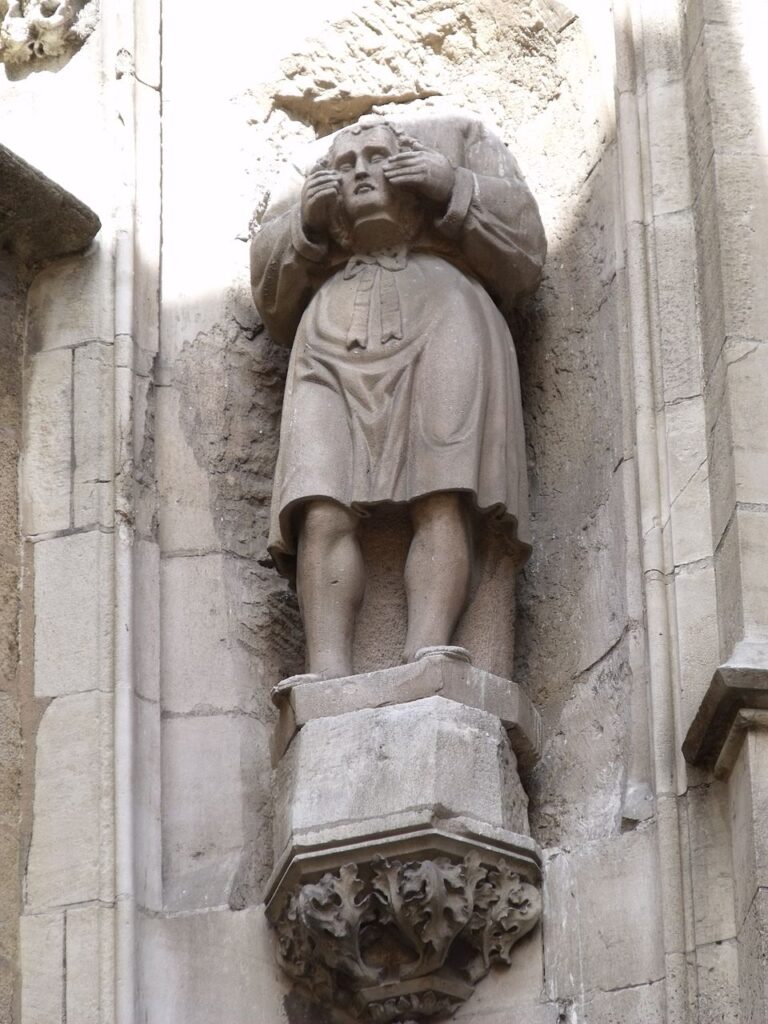
Sixteenth-century statue of a beheaded Mitre at the cathédrale Saint-Sauveur at Aix-en-Provence, by sculptor Jean Mone (1512-1513). Soure: Wikipedia Commons
The ninth-century martyrologies did create a problem: a martyr’s Vita could not refer to him as a mere confessor. In two later manuscripts of Mitrias’ Vita, a fourteenth-century legendarium and a fifteenth-century breviary from Aix, the story was therefore ‘corrected’.[15] The term ‘confessor’ was simply replaced with ‘martyr’, the cathartic death of his cruel master was removed, and the statement that Mitrias lived happily ever after was replaced with the remark that he was martyred on the 13th of November.[16] The earlier version of the story did not completely go out of fashion: the Codex Paderbornensis Theodorianus Ba 2, copied around 1460, contains the legendarium of Böddeken with the story of Mitrias the confessor.[17] Curiously, it does place Mitrias’ feast day on the Ides of November, a detail not included in earlier version of the Vita that identifies Mitrias as a confessor. Through the miracle of the mixing and matching of sources, even the poor confessor Mitrias whose ‘glory of the passion’ was taken away from him by his cruel master could now have a feast day of his own!
[1] Michel Carrias, Saint Mitre d’Aix. Étude hagiographique, Aix-en-Provence, La Pensée Universitaire, 1969, p. 59.
[2] Carrias, Saint Mitre d’Aix, p. 27.
[3] Gregory of Tours, Liber in gloria confessorum, ed. Bruno Krusch, MGH SS rer. Merov. 1,2, Hannover: Hahn, 1885, cap. 70, pp. 338-339; trans. Raymond van Dam, Glory of the Confessors, Liverpool, Liverpool University Press, 1988, pp. 73-74.
[4] Gregory of Tours, Liber in gloria confessorum, cap. 70, pp. 338-339; trans. van Dam, Glory of the Confessors, pp. 73-74.
[5] Carrias, Saint Mitre d’Aix, p. 183-184.
[6] Gregory of Tours, Liber in gloria confessorum, cap. 70, p. 339.
[7] Carrias, Saint Mitre d’Aix, p. 185.
[8] Gregory of Tours, Liber in gloria confessorum, cap. 70, p. 338.
[9] Gregory of Tours, Liber in gloria confessorum, cap. 70, p. 339.
[10] Carrias, Saint Mitre d’Aix, pp. 180-182.
[11] Carrias, Saint Mitre d’Aix, p. 39.
[12] Ado of Vienne, Martyrologium, in Jacques Paul Migne (ed.), Patrologia Latina, vol. 123, Paris, Garnier, 1879, p. 394C, https://archive.org/details/patrologiaecurs29goog/page/n200/mode/2up (accessed 13/01/2026).
[13] Usuard, Martyrologium, in Jacques Paul Migne (ed.), Patrologia Latina, vol. 124, Paris, Garnier, 1879, p. 690B, https://archive.org/details/patrologiaecurs76unkngoog/page/n348/mode/2up (accessed 13/01/2026).
[14] Boston Catholic Journal, “Roman Martyrology, Complete”, https://www.boston-catholic-journal.com/1959-roman-martrylogy-in-english/roman-martyrology-1959-november-in-english.htm (accessed 13/01/2026).
[15] Carrias, Saint Mitre d’Aix, p. 199.
[16] Carrias, Saint Mitre d’Aix, pp. 199-200, 49.
[17] Hans-Walther Stork, , “Paderborn, Erzbischöfliche Akademische Bibliothek, Ba 2”, 2024, https://resolver.staatsbibliothek-berlin.de/HSP0006C5BE00000000 (accessed 13/01/2026).