
Blog
Hideous black spirits and terrifying persons

In compiling two books about saints – martyrs in the case of the Gloria martyrum, and confessors in the Gloria confessorum – Gregory of Tours offers a Christian exemplary alternative to the mythology of the gods and heroes of Classical Antiquity. He does not ask his audience to simply give up the ‘deceitful myths’ they look up to, with nothing in return. Instead, he offers an alternative. Christianity has plenty of heroes of its own, and Gregory’s work will prove the point: the Greek and Roman myths are the evil within, the Christian saints are salvation.
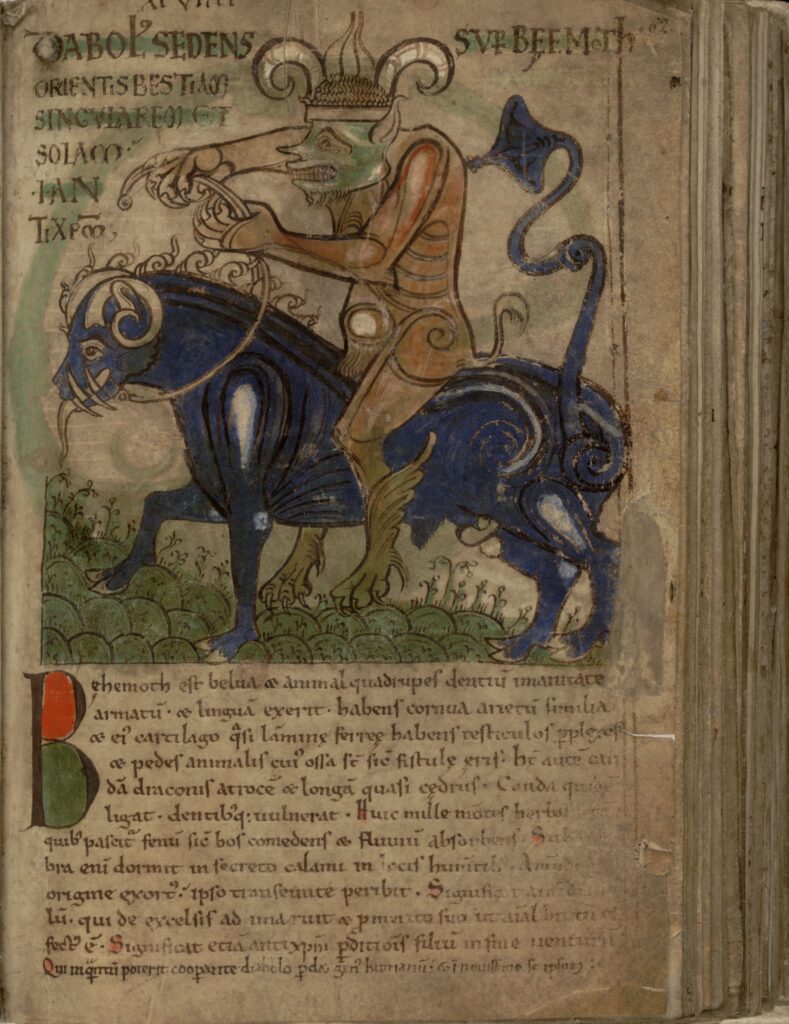
Image from Lambert de St Omer’s Liber Floridus (c. 1121): the Devil riding the beast Behemoth from the Book of Job. Source: University Library Ghent, BHSL.HS.0092, fol. 62r
This blog post explores the way in which Gregory presents the stories about saints and martyrs to his audience, focussing in particular on his extensive utilisation of apparitions. Many of his stories revolve around appearances of saints or other figures sent from heaven to communicate with those within the earthly plane. Gregory’s penchant for apparitions is not unique within the Merovingian world: supernatural visitations are found in Merovingian histories, hagiographies and poetry, and are richly represented also in the visual culture of the period.[1] Such visionary events could offer tangible and accessible insights into the world beyond, which made them a powerful and effective tool of medieval religious doctrine. This blog post offers a survey of Gregory’s use of apparitions in the Martyrs and the Confessors: who or what appears, what do such apparitions look like, and how do these apparitions facilitate the audience’s understanding of Gregory’s stories and his underlying message.
What is – and isn’t – a vision?
An important characteristic of the myths Gregory abhors, is the intervention of gods in the life of humans. In many cases, this divine intervention comes in the shape of a god appearing in human form – or as an animal – to the beneficiaries of the intervention. Christianity has a pointed equivalent to this phenomenon, albeit one with an intermediary step: God first acted upon the world through Jesus as the physical manifestation of the Trinity, and subsequently through the saints, who are deeply attuned to the divine and thus qualified to represent God himself.[2]
Saints are not immortal, however, and especially those who are martyred spend little time on the physical plane. Most interactions between humans and saints therefore occur across the boundary between the earthly and the heavenly.[3] The occasional appearance of a saint served as confirmation of the power of their shrine and the miracles associated with it, encouraging the faithful to keep up their worship.[4] In Merovingian Gaul, relic-cults and associated saints’ lives were particularly popular, and so, in turn, were descriptions of visionary events.[5] Gregory thus demonstrates in his Martyrs and Confessors that he knows his genre and its Merovingian audience well, and is able to use the conventions of his time to convey his literary message.
Some distinctions need to be made in the typology of these visionary events, with Merovingian and modern terminology not always corresponding. While Gregory himself typically uses visio or visum to refer to the phenomenon of a cross-over between the earthly and the heavenly, the term ‘vision’ is used in modern scholarly literature to designate an event in which the human’s spirit is temporarily transported into the heavenly plane.[6] This type of event is commonly associated with the process of dying or death. The visionary either gets a preview of their own afterlife, which confirms their moral rectitude or gives them a chance to correct errors, or the visionary finds themselves taken to a loved one who has passed on, who may need help in the form of prayers, or who simply reassures the visionary that all is well.[7] A figure from the heavenly plane can assist in this crossing of boundaries between planes, but it is primarily the visionary who is transported. The transportation between planes creates a rift between the physical body and the inner conscience, with the visionary’s body remaining on the earthly plane while the soul is elsewhere: it is through the spiritual inner senses rather than the five external senses, that the human stands in contact with the world beyond – the physical sensory organs remain where they were before the vision began, and are only returned to after the vision has ended, and the visionary’s body and soul have been reunited again. This aligns with the separation of body and soul after death, which can explain the common association between visions and a setting involving death.
This is not, however, what happens in Gregory of Tours’ works when he describes a visio or visum. Gregory’s visionaries see, hear and sometimes even physically feel the heavenly plane that temporarily opens up to them, allowing for the appearance of someone – or something – from the world beyond our own. The perception of these appearances by the human seeing them consists of external, rather than internal and spiritual, sensory input. One example of a visionary event clearly illustrates this physicality of the ‘visions’ described by Gregory: a blind boy is repeatedly visited by “a voice … carried to his ear”,[8] ordering him to crawl under the funeral bier of the recently deceased confessor Nicetius, so that he may receive his sight. The boy ultimately obeys, and “immediately his eyes were opened”. Later, St Nicetius appears to him in a vision (apparuit ei … per visum), indicating that now that the boy is able to see with his physical eyes, he has equally gained the ability to perceive visual input coming from the heavenly plane where St Nicetius originates from. If these two events were visions as they are defined in modern scholarship, there would be nothing preventing the boy from equally ‘seeing’ a person to go along with the voice he hears before receiving his sight: the spiritual inner senses, after all, are not restricted by any physical impairments that may be present. The fact that the ‘visions’ in this story only gain a visual dimension after the boy’s blindness has been healed, shows that the saint is seen through the physical eye rather than the mind’s eye, although Merovingian writers disagree on whether this ‘seeing’ is the result of real sensory input, or rather an illusion taking place through the external senses.[9]
Modern scholarship on visionary events refers to this phenomenon as an ‘apparition’, which is distinct from a vision, although the latter is often used as an umbrella term in non-specialist literature. Gregory and his contemporaries, as said, use a blend of terms (visions, dreams, apparitions, oracles) to refer to the general category of visionary events, without clearly associating each term with its own, unique subcategory.[10] The terminology used in this survey will therefore be that of modern scholars, of which the following distinction is central: the recipient of an apparition does not experience a separation of body and soul characteristic of a vision, in which the soul is temporarily transported into the heavenly plane. Instead, it is the apparition that enters the earthly plane and is perceived through the human’s external senses.
Gregory’s view on apparitions
Gregory of Tours’ Martyrs and Confessors exclusively describe apparitions. Of the staggering 71 occurrences of communication across the boundary between the earthly and the heavenly in these two texts – 40 in the Martyrs, and 31 in the Confessors – none involve an out-of-body experience for the recipient.[11] It would therefore seem that in Gregory’s perception, martyrs and confessors are the acting party whenever a divine intervention occurs, while the human is a passive recipient.
This is further accentuated by the extent of the communication between planes: only in a handful of cases, almost all of which include St Martin as either the recipient or the appearing entity, does the recipient engage in a dialogue with the person appearing to them. In all other cases, only the apparition speaks, usually in the form of either a concrete request or a general admonition announcing impending consequences in the case that the recipient does not change their ways. The recipient is then left to act on what has been said to them – or not – but the communication Gregory describes remains unidirectional.
Gregory is also remarkably consistent in the way in which this information is transmitted. The Roman philosopher Macrobius, writing a century before Gregory, identified five types of ‘dreams’ (which can, as mentioned above, be interpreted to include all sorts of visionary events): enigmatic dreams, prophetic visions, oracular dreams, nightmares, and phantasms.[12] According to Macrobius, the first three types of events offer a concrete message to their recipient, distinguished from each other through the form in which this message is delivered: enigmatic dreams require interpretation to be understood; prophetic visions show the visionary an image or event which later comes true; and oracular dreams contain a clear, unambiguous message that is transmitted verbally by a person. Gregory almost exclusively uses just one of these blueprints, namely the oracular type. Nearly all of his apparitions are ‘diegetic’ events: their message and meaning are made explicit both to the apparition’s narrative recipient and to Gregory’s audience. As we will see when shifting our focus to other characteristics of his descriptions of apparitions, this clarity of the transmitted messages aligns with other editorial choices intended by Gregory to promote the accessibility of his texts.
While the direction and delivery of the communication in Gregory’s texts almost universally follow the same pattern, the identity of the apparitions themselves is significantly more varied. Graphs 1 and 2 below offer an overview of the form the apparitions take in respectively the Martyrs and the Confessors, categorised as follows:
- ‘human’, including both actual humans, and angels taking on a human appearance;
- ‘demonic’;[13]
- ‘amorphous’, containing all apparitions which take no discernible shape, but rather consist of, in most cases, ‘light’ or ‘shadow’.[14]
Graphs 3 and 4 further divide the human apparitions into categories.
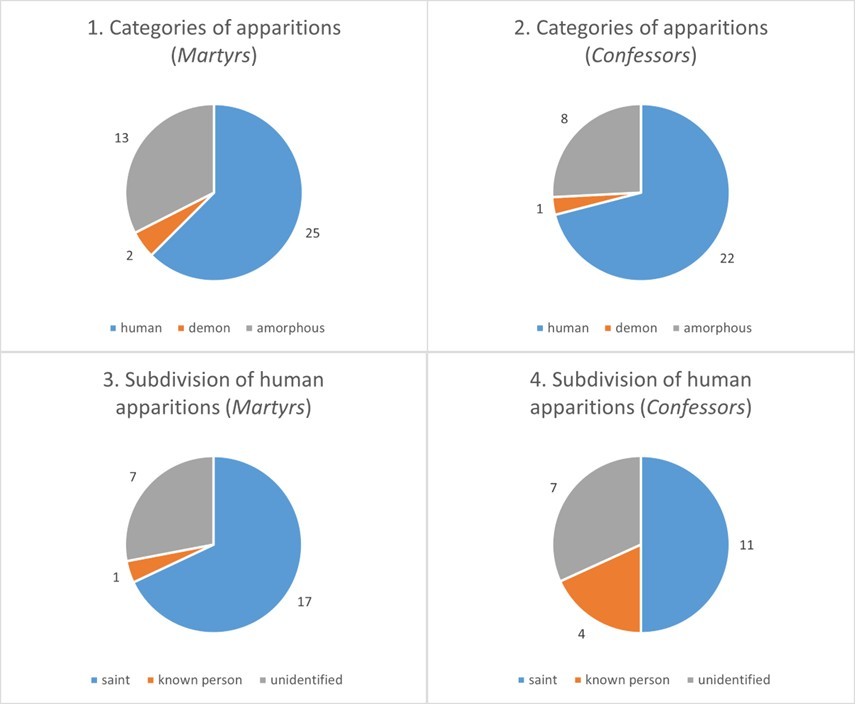
A few patterns stand out based on these divisions:
- Saints, including both martyrs and confessors, make up the vast majority of the human apparitions in the Martyrs and Confessors, which is unsurprising considering the focus of these texts. Female saints make up a small minority in the Martyrs and Confessors, and they are equally underrepresented in the apparitions. However, while only 18% of the Martyrs’ saintly apparitions is female, the percentage in the Confessors is higher: 45%.[15]
- The category ‘known person’ includes both those identified by name by Gregory, and those who remain unidentified to the texts’ audience but are known to the person seeing them. In the Confessors, known persons who are not saints are much more common than in the Martyrs.[16] The known persons of the Confessors are more mundane and include a duo of regular, unassuming priests whose primary distinctive characteristic is their singing skill, and a husband appearing to his wife. This coexistence of clerics and laypersons as apparitions would seem to fit well with Gregory’s sixth-century milieu: the Merovingian period saw an increased sensitivity to the openness of the laity towards the holy.[17]
- While demons are a quantitative minority, they do stand out in terms of the number of words spent describing them, as we will see in the next section.
- Unidentified persons in the Martyrs are exclusively male, both in the singular and plural. In the Confessors, by contrast, the gender of an unidentified person or group is usually left unspecified. In these cases, Gregory will simply refer to ‘a person’ (persona) or ‘a crowd’ (multitudo), rather than the omnipresent ‘man’/‘men’ (vir/viri) of the Martyrs.
Apparitions and their appearances
For almost all of Gregory’s apparition, their description consists of a relatively fixed sequence of elements. The standard formula is as follows:
Apparuit[ei][persona] per visum (noctis), dicens: “[direct speech]”
[appearing entity] appeared to [recipient] in a vision (at night), saying: “[direct speech]”Small variations occur: the replacement of the detail ‘at night’ with ‘in a dream’, visum with visio, and dicere with a form of aio are the most common variants.
In addition to the above elements, Gregory sometimes offers supplementary information, which further facilitates the audience’s understanding of the story in various ways. Of the 71 total descriptions of apparitions, 32 contain an additional element that gives an indication of the appearance of the apparition beyond the basic identification of their form (i.e. human, demonic or amorphous). 20 of these descriptions occur in the Martyrs (50% of apparitions have a further description), and 12 in the Confessors (39% of apparitions have a further description). The form of these descriptions of the apparition’s appearance varies considerably, as graphs 5 and 6 show.
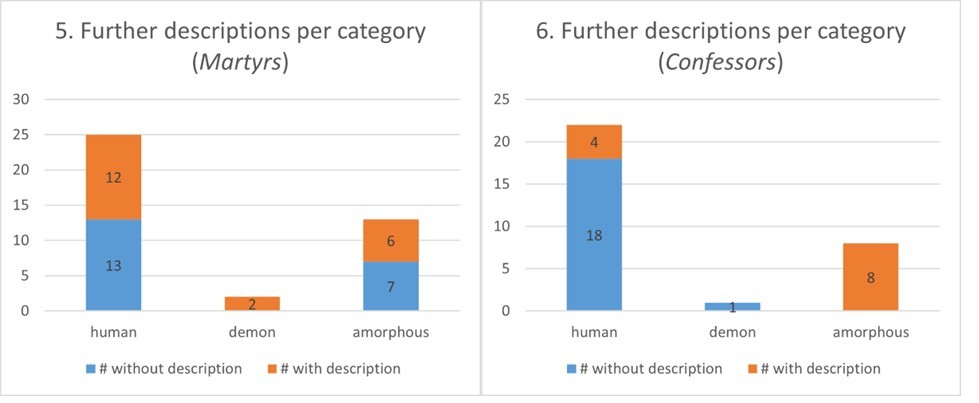
A few patterns can be observed:
- While the Martyrs only has two demons appearing as apparitions, both are described in detail (see also the table below). The one demonic apparition in the Confessors, by contrast, does not receive any further details.
- These demons are a notable exception to Gregory’s preference for oracular events that include a clearly stated verbal message. The demonic apparitions communicate first and foremost through their demonic nature and appearance. This renders them atypically enigmatic apparitions, which require interpretation for their message to become clear.
- In the Martyrs, both human and amorphous apparitions are further described about half of the time. In the Confessors all eight amorphous apparitions are described beyond the statement that something appears, while only a few humans require additional details in Gregory’s perception.
Such additional descriptions come in essentially two types: they can either focus on objective physical characteristics such as colours, clothing or particular visual traits, or they can tap into the visceral emotional impact triggered by the apparition’s appearance. Combinations exist, although they constitute a small minority. Compare, as an illustration for this subdivision, the following descriptions:
| physical characteristics | emotional impact | combination |
| psallentes homines in vestimentis albis
men dressed in white, chanting psalms (Martyrs, ch. 12) |
daemonis umbra[18] intolerabilis
the intolerable shadow/spirit of a demon (Martyrs, ch. 5) |
umbra squalida atque funesta, quae nihil minus vultu quam diabolum similabat
a foul and dismal shadow/spirit, whose likeness was similar to nothing except a demon (Martyrs, ch. 28) |
Colour is an element occurring in both positive and negative contexts. It may not come as a surprise that the formula of ‘men dressed in white, chanting psalms and carrying candles’ (psallentes homines in vestimentis albis, accensis cereis) occurs in full no fewer than four times in 32 descriptions. A fifth description contains part of it, in the form of St Stephen wearing a white garment that is still dripping with sea water from his saving a ship from sinking just moments before appearing in this next place.[19] While Gregory consistently associates white clothing with sanctity, he does not exclusively link darkness to evil entities. Both descriptions of demons featured in the table above contain the word ‘shadow’ (umbra), but we also find a dark colour in the description of St Paschasia: she appears ‘with a black garment, a head like a swan’s and a splendid face’ (nigra veste, cigneo capite vultuque decora).[20] The specific vocabulary used to describe a dark colour is crucial here: umbra (subt. shade/shadow) is a highly ambiguous term, but Gregory uses it in a negative sense: a catch-all for demonic presences, including both aspects of visual darkness and the terror of a humanoid but inhuman figure in one single term. The adjective nigra (adj: black), conversely, is used in the context of the clothing of a pious, elderly nun, who additionally has pure white hair (which may be inferred from the somewhat roundabout ‘head like a swan’s’ (cigneo capite). Gregory does not indicate hair colour anywhere else in these two texts, neither for apparitions nor for those inhabiting the earthly plane, so it can be assumed that Paschasia’s hair colour is included as a convenient white element rather than being seen as important information in itself. For the purposes of the description, a white head covering, commonly associated with a nun’s habit, would have had the same effect.
Adjacently to colour, most amorphous apparitions are described as either ‘a light’ (lux) or ‘a ball of fire’ (globus ignis), with various associated adjectives, of which the most common by far is ‘large’ (magnus/magna). Gregory explicitly associates this phenomenon several times with St Martin, out of whose head once rose a ball of fire as he was preaching, but Gregory also uses the description in other events. In the Confessors, all eight amorphous apparitions are associated with one or more of the words ‘light’, ‘bright’, or ‘fire’. In the Martyrs, four out of the six amorphous apparitions that are given additional detail, have one or more of these words attached to them – the remaining two are described as being reminiscent of certain objects. The high rate of additional description of non-humanoid apparitions is theologically telling. While saints, demons, and regular humans have clear imagery associated with them, the general presence of the divine has no fixed shape which can be grasped by the human senses.[21] Instead, God is then represented as something that is known to those still within the earthly plane: light. The additional descriptors are thus necessary to help the audience attempt to picture what such a divine apparition looks like, even if the reality of God’s appearance eludes both the human mind and senses. In line with Gregory’s other efforts to make his stories of saints understandable and accessible, his attempt to capture divinity in an image that can be pictured by his readers increases the tangibility of God for a non-specialist audience seeking to understand what they cannot see.
Visual and moral guidance sometimes demands more specific and context-dependent descriptions. A Jewish boy who apparently does not know the name of Mary, describes seeing ‘the woman, sitting on the throne in that church, cradling a little baby in her lap’ (mulier, quae in basilicam illam […] in cathedra resedens, parvulum in sinu gestat infantem), allowing the Christians hearing his story to conclude that Mary herself has appeared to him, based on their knowledge of Mary’s appearance.[22] Similarly, St Eutropis, who was martyred with an axe, is seen with ‘a scar on [his] head where the blade of the axe had struck’ (cicatricem capitis, qua in parte defixum fuerat securis acumen), which proves to those he visits that it really is Eutropis they are seeing.[23] In certain cases, a reference to the state of a martyr’s earthly body would hinder rather than help identification: thus the 48 martyrs burnt to ashes at Lyon and then sprinkled into the Rhone are miraculously seen ‘intact and unwounded’ (integri ac inlaesi), as proof of their sanctity.[24] In still other instances, descriptions fulfil a specific plot-related function. This is the case with St Stephen’s dripping garment, mentioned above: the whiteness of the garment signals the wearer is a holy man, but the sea water dripping from the saint’s clothing serves as proof that he has just performed a miracle elsewhere.
The appearance of an apparition in Gregory’s works therefore depends on the message he seeks to convey in a particular context. Sometimes he purposely refrains from giving away too much. There was considerable discussion in the sixth century on what the world beyond our own looked like.[25] Yet whereas Gregory generally spoke his mind in matters of doctrine, he did not consider it helpful to commit fully to a particular view of the afterlife in his hagiographies. Instead, he opted for a middle ground that combined belief in instant purification after death with the notion of an afterlife in which individuals were frozen in time until the Last Judgement.[26] Gregory is not the only writer to opt for such a hybrid representation of the afterlife: the monk Barontus, whose story was recorded in writing approximately a century after Gregory’s death, presents an extensive vision which includes both purified souls in their flawless state, and ragged souls awaiting the final judgement. Jesse Keskiaho recently hypothesised that texts whose primary function was to propagate saints’ lives to a wider audience were less likely to problematise the specifics of visionary events than texts with a theological-academic purpose.[27] This would certainly seem to be the case in the Martyrs and Confessors: by not choosing sides in advanced theological debates, Gregory could instead focus fully on his essential mission of the presentation of the saints as exemplary figures, remaining on an elementary, accessible level of theology.
The good, the bad and the ugly
As this brief survey has shown, Gregory of Tours’ Gloria martyrum and Gloria confessorum contain not only a large number, but also a great variety of apparitions. Apparitions come in all shapes and sizes, which are in many cases further described to further the plot or to add to the impact of the event. From the holy image of a group of men dressed in white, chanting psalms and carrying candles, to the fearsome balls of fire or light flying by or even rising from someone’s head, to the unbearable, hideous darkness of demons; Gregory has an apparition for every occasion.
The stories he tells of the saints generally contains enough detail to get to know the saint in question and understand their power, resulting in stories that are easily accessible to anyone open to the message they aim to convey.[28] The omnipresence of apparitions plays an important role in this: visible signs of God’s intervention within the earthly plane, be it through a person appearing and verbally stating a message or through something more suggestive such as a ball of light, are understandable proof of His power, regardless of the theological education of his readers.
It is clear from Gregory’s attention to detail when writing about these visa that he was aware of the edifying nature of the apparitions in his texts. Their already illuminating presence is further supported by complementary descriptions: sanctity is emphasised through white garments and psalms being sung, appearing light is not merely ‘light’ but ‘a light that was brighter than a human light’ or ‘small light becoming a huge beacon’, and that which is evil is not simply evil, but additionally ‘intolerable’ or ‘foul and dismal’. These vivid descriptions in the Martyrs and Confessors serve as proof of Gregory’s adeptness as a moral educator. Rather than choosing to contribute to Merovingian debates on the afterlife and its specificities, he presents two collections of stories which not only enable easy understanding and retelling, but even encourage such interaction. The Martyrs and the Confessors are not mere theological texts. They are first and foremost collections of short stories, and that is precisely what allowed them to serve as alternatives to the Greek and Roman myths Gregory of Tours abhorred.
[1] Isabel Moreira, “Visions and the Afterlife”, in The Oxford Handbook of the Merovingian World (eds Bonnie Effros and Isabel Moreira), Oxford, Oxford University Press, 2021, pp. 988-1011.
[2] Moreira, “Visions and the Afterlife”, p. 993.
[3] Jesse Keskiaho, Dreams and Visions in the Early Middle Ages. The Reception and Use of Patristic Ideas, 400–900, Cambridge, Cambridge University Press, 2015, p. 6.
[4] Moreira, “Visions and the Afterlife”, p. 993.
[5] Keskiaho, Dreams and Visions, p. 15.
[6] Peter Dinzelbacher, Revelationes, Turnhout, Brepols, 1991.
[7] Moreira, “Visions and the Afterlife”, p. 998.
[8] Gregory of Tours, Liber in gloria confessorum, ed. Bruno Krusch, MGH SS rer. Merov. 1,2, Hannover: Hahn, 1885, cap. 60, pp. 332-333; trans. Raymond van Dam, Glory of the Confessors, Liverpool, Liverpool University Press, 1988, p. 66.
[9] Keskiaho, Dreams and Visions, pp. 21-22.
[10] Moreira, “Visions and the Afterlife”, pp. 992-993.
[11] This is the number of events verbally identified by Gregory himself as a visio or visum, or unequivocally identifiable as such by the use of related words. Repeated but distinct appearances by the same person or other entity are counted separately. Some events occur throughout the Martyrs and Confessors that may be interpreted as apparitions – notably, Jesus coming from heaven with his angels to collect first Mary’s soul and then her body after her passing – but for the sake of consistency, Gregory’s own demarcation is retained. Additionally, the event must be seen by a recipient or group of recipients: miraculous appearances described in a general sense are excluded here. Also excluded is the miraculous materialisation of real, tangible objects out of thin air (e.g. a candle being lit with no person involved). While for the purposes of the database, ‘visions’ were only included when they had a clear message associated with them, this survey does include apparitions with no explicit communicative aspect.
[12] Macrobius, Commentary on the Dream of Scipio (ed./trans. William Harris Stahl), New York, Columbia University Press, 1952, pp. 87-90.
[13] The involvement of demons in visions is not unambiguous: the distinction between the divine and the demonic could be up for debate (cf. Moreira, “Visions and the Afterlife”, p. 991). Here, Gregory’s judgement has been followed.
[14] Notably, no non-humanoid living creatures appear in Gregory’s visionary events: an apparition is either a person or a demon, or has no distinct form at all.
[15] This number is somewhat skewed by the prolificacy of St Vitalina as an apparition: she accounts for 3 of the 11 female saintly apparitions in the Confessors. While female apparitions are rare, female visionaries are on the rise in Gregory’s time. The identity of the recipients of apparitions in Gregory’s texts have not been mapped out for this analysis, but a cursory reading suggests that the gender ratio might be different on the receiving end, with a relatively higher number of women involved.
[16] Additionally, the one known non-saint in the Martyrs is still an archdeacon, so while he is not officially a saint, he is a high-ranking church official who displays exemplary behaviour that could very well have led to his being included among the confessors of Gregory’s other book.
[17] Moreira, “Visions and the Afterlife”, p. 997.
[18] Umbra is a highly ambiguous term: it can, among other things, refer to shadows cast by objects; shadows cast by persons in a neutral sense; a dark humanoid appearance in itself, usually associated with death; the general absence (or even opposite) of light; or it may serve as a metaphor for ignorance (‘being in the dark’). The context of Gregory’s uses of umbra suggests that he uses it as a catch-all for demonic presences, including both aspects of visual darkness and the terror of a humanoid but inhuman figure in one single term. Cf. Nováková, Julie, Umbra. Ein Beitrag zur dichterischen Semantik, Berlin, De Gruyter, 1964.
[19] Gregory of Tours, Liber in gloria martyrum, ed. Bruno Krusch, MGH SS rer. Merov. 1,2, Hannover: Hahn, 1885, cap. 33, p. 59.
[20] Gregory of Tours, Liber in gloria martyrum, cap. 50, p. 73.
[21] Keskiaho, Dreams and Visions, p. 9.
[22] Gregory of Tours, Liber in gloria martyrum, cap. 9, p. 44.
[23] Gregory of Tours, Liber in gloria martyrum, cap. 55, p. 76.
[24] Gregory of Tours, Liber in gloria martyrum, cap. 48, p. 72.
[25] Moreira, “Visions and the Afterlife”, p. 999.
[26] While the notion of purgatory is emerging at the time of Gregory’s writing, the Martyrs and Confessors do not include any references to purgatory. Heaven is rarely explicitly referred to, but it can be inferred that it is where the saints and other friendly apparitions come from. Hell, on the other hand, is the source of appearing demons, and additionally serves as an instant punishment for those who are beyond absolution through earthly penance: on several occasions, Gregory concludes a story with the description of a sinner being swallowed whole by the earth and going straight to hell.
[27] Keskiaho, Dreams and Visions, p. 11.
[28] Moreira, “Visions and the Afterlife”, p. 993.